
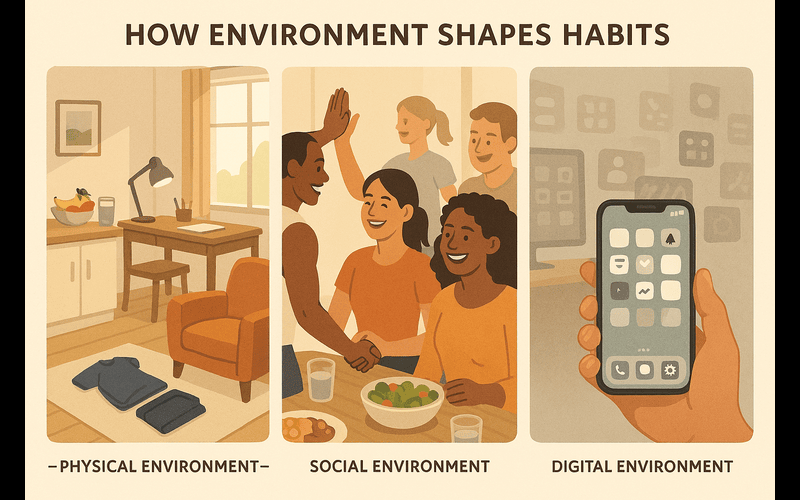
Have you ever noticed how differently you behave depending on where you are? You might eat healthier at home, concentrate better in a quiet café, or feel more motivated to exercise when the sun is shining. That’s not a coincidence. Our environment silently shapes our habits every single day.
Habits are often described as personal choices driven by motivation and discipline. While those factors matter, the spaces we live and work in have a powerful influence on what we repeatedly do. In fact, our surroundings can make good habits easier—or bad habits almost automatic.
The Physical Environment: Design Shapes Behavior
The layout of a room, the objects within reach, lighting, noise levels, and even colors all influence behavior.
For example, if healthy snacks are placed on the kitchen counter and junk food is hidden in a cupboard, you’re more likely to reach for the healthier option. If your phone is on your desk while you work, you’ll check it more often. When your workout clothes are laid out the night before, exercising in the morning becomes more likely.
This is not about willpower—it’s about friction. Environments that reduce friction for positive actions make those actions easier to repeat. On the other hand, environments that increase friction for negative behaviors help you avoid them.
Even small changes matter:
- A clean desk encourages focus.
- Natural light improves mood and productivity.
- A comfortable reading chair increases the likelihood of reading regularly.
Designing your environment intentionally is one of the simplest and most effective ways to build lasting habits.
The Social Environment: We Mirror Others
Humans are deeply social creatures. We adapt our behavior to match the people around us, often without realizing it.
If your friends prioritize fitness, you’re more likely to exercise. If your coworkers stay late every day, you might feel pressure to do the same. If your family eats dinner together without phones, that behavior becomes normal.
Social norms are powerful habit builders. We tend to:
- Copy behaviors we see frequently.
- Seek approval from our group.
- Avoid actions that might cause rejection.
This is why joining a community aligned with your goals can transform your habits. Surrounding yourself with people who already live the way you want to live makes change feel natural rather than forced.
The Digital Environment: The Invisible Influence
In today’s world, our digital environment may influence us even more than our physical one.
Notifications, social media feeds, recommendation algorithms, and constant connectivity shape how we spend our time and attention. If your phone is filled with educational apps, podcasts, and productivity tools, your habits will reflect that. If it’s filled with endless scrolling platforms, your time may disappear without you noticing.
Digital clutter can be just as disruptive as physical clutter. Curating your digital space—turning off notifications, organizing apps, limiting screen time—can dramatically shift your daily behavior.
Creating an Environment That Works for You
The key insight is simple: behavior is often a response to context.
Instead of relying solely on motivation, ask yourself:
- What in my environment makes this habit easy?
- What makes it difficult?
- What small change could nudge me in the right direction?
You don’t need dramatic life changes. Start small:
- Rearrange your workspace.
- Place visual reminders where you’ll see them.
- Spend more time with people who embody your desired habits.
- Clean up your digital space.
When your environment supports your goals, good habits feel natural. And when good habits become natural, personal growth becomes sustainable.
Your surroundings are not just a backdrop to your life—they are one of the most powerful tools for shaping it.
Final Thought
Just as physical and digital environments shape our daily habits, the environments we create in our careers and businesses shape our success. The structure of your workspace, the design of your website, and the people you surround yourself with all influence your growth. When you intentionally design your environment — whether digital or professional — you don’t just change your habits. You change your trajectory.